Your Connection to Allah on the Sacred Journey
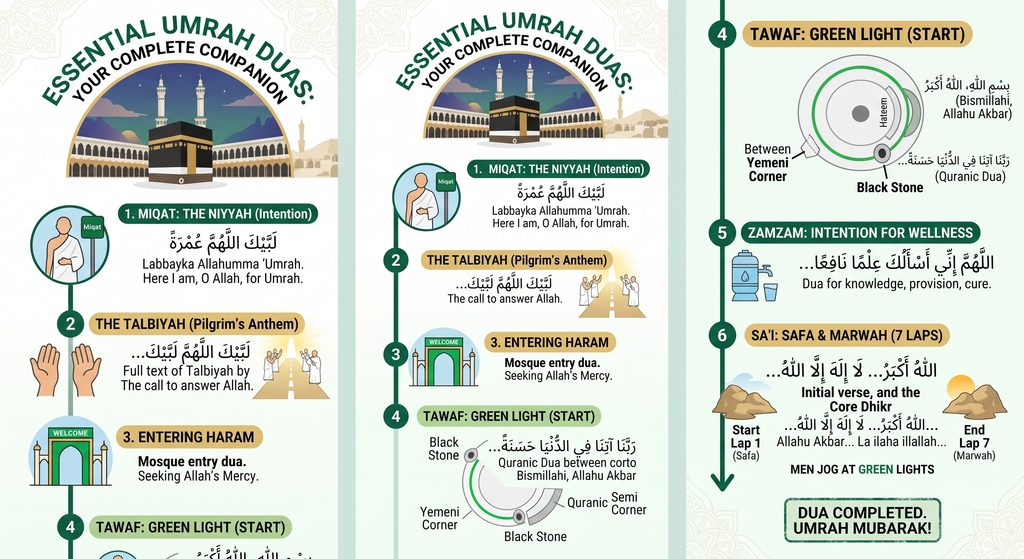
Entering Makkah and the Masjid al-Haram is not just a physical arrival; it is a profound spiritual connection. Every step—from the Miqat to the completion of Sa’i—is punctuated by specific supplications that define the rites of Umrah. These are the words used by prophets and the pious who came before us.
This guide provides the core Duas you will need. While there are no mandated scripts for most of Tawaf and Sa’i (you may read Quran or use your own language), specific points on the journey require specific words to be valid or to align with the Sunnah. We have included clear Arabic text, English transliteration (to help with pronunciation), and the full meaning.
1. Before Miqat: Ghusl and Preparation
Before putting on the Ihram garments, it is recommended (Sunnah) to perform a full body wash (Ghusl) and trim hair and nails. As you prepare, you can recite this intention for purity:
اللَّهُمَّ اجْعَلْنِي مِنَ التَّوَّابِينَ وَاجْعَلْنِي مِنَ الْمُتَطَهِّرِينَ Allahummaj’alnee minat-tawabeena waj’alnee minal-mutatahhireen. “O Allah, make me among those who turn to You in repentance, and make me among those who are clean.”
2. At the Miqat: The Niyyah (Intention)
Once your physical preparation is complete, you must cross the Miqat boundary with a pure heart and declare your intention. Umrah begins here.
لَبَّيْكَ اللَّهُمَّ عُمْرَةً Labbayka Allahumma ‘Umrah. “Here I am, O Allah, for Umrah.”
3. The Talbiyah: The Anthem of the Pilgrim
Immediately after declaring your intention, you must begin reciting the Talbiyah frequently, raising your voice slightly (for men). This continues until you are ready to begin Tawaf.
لَبَّيْكَ اللَّهُمَّ لَبَّيْك، لَبَّيْكَ لاَ شَرِيكَ لَكَ لَبَّيْك، إِنَّ الْحَمْدَ وَالنِّعْمَةَ لَكَ وَالْمُلْك، لاَ شَرِيكَ لَك Labbayka Allahumma labbayk, labbayka laa shareeka laka labbayk. Innal-hamda wan-ni’mata laka wal-mulk, laa shareeka lak. “Here I am, O Allah, here I am. Here I am, You have no partner, here I am. Verily all praise, blessings, and sovereignty belong to You. You have no partner.”
4. On Entering Makkah / Masjid al-Haram
When entering the Haram, step in with your right foot and recite the standard mosque supplication:
بِسْمِ اللَّهِ، وَالصَّلَاةُ وَالسَّلَامُ عَلَى رَسُولِ اللَّهِ، اللَّهُمَّ افْتَحْ لِي أَبْвоَابَ رَحْمَتِكَ Bismillahi was-salatu was-salamu ‘ala Rasulillah. Allahummaftah li abwaba rahmatik. “In the name of Allah, and blessings and peace upon the Messenger of Allah. O Allah, open for me the doors of Your mercy.”
5. Upon First Sight of the Kaaba
The first moment your eyes fall upon the Kaaba is a powerful, protected moment. Lower your gaze until you find a quiet spot, away from the flow of traffic, then raise your hands and supplicate. Supplications are answered in this moment.
You can make any heartfelt dua, but this one is often recommended:
اللَّهُمَّ زِدْ هَذَا الْبَيْتَ تَشْرِيفًا وَتَعْظِيمًا وَتَكْرِيمًا وَمَهَابَةً، وَزِدْ مَنْ شَرَّفَهُ وَكَرَّمَهُ مِمَّنْ حَجَّهُ أَوِ اعْتَمَرَهُ تَشْرِيفًا وَتَكْرِيمًا وَتَعْظِيمًا وَبِرًّا Allahumma zid hadhal-Bayta tashreefan wa ta’dheeman wa takreeman wa mahabatan, wa zid man sharrafahu wa karramahu mimman hajjahu awi’tamarahu tashreefan wa takreeman wa ta’dheeman wa birra. “O Allah, increase this House in honor, greatness, nobility, and awe; and increase those who honor it and ennoble it, among those who perform Hajj or Umrah, in honor, nobility, greatness, and piety.”
6. Tawaf Duas (The 7 Circuits)
During the first 3 brisk circuits (Raml, men only) and the final 4 normal circuits, you may make any personal dua. However, two specific supplications are mandatory or Sunnah:
A. Starting at the Black Stone (Istilam)
Each of the 7 circuits begins by facing the Black Stone (or the green light indicator line) and raising your palms toward it, saying:
بِسْمِ اللَّهِ، اللَّهُ أَكْبَرُ Bismillahi, Allahu Akbar. “In the name of Allah, Allah is Greatest.”
B. The Quranic Dua (Between the Yemeni Corner and the Black Stone)
Recite this Dua during every circuit, between the Yemeni Corner (Rukn al-Yamani) and the final completion line:
رَبَّنَا آتِنَا فِي الدُّنْيَا حَسَنَةً وَفِي الآخِرَةِ حَسَنَةً وَقِنَا عَذَابَ النَّارِ Rabbana atina fid-dunya hasanatan wa fil-akhirati hasanatan wa qina ‘adhaban-nar. “Our Lord, grant us good in this world and good in the Hereafter, and protect us from the punishment of the Fire.”
7. After Tawaf: 2 Rak’ahs & Zamzam
Pray 2 Rak’ahs behind Maqam Ibrahim (or anywhere in the Haram). In the first Rak’ah recite Surah Al-Kafirun; in the second, recite Surah Al-Ikhlas. Afterward, drink Zamzam water with this intention for wellness:
اللَّهُمَّ إِنِّي أَسْأَلُكَ عِلْمًا نَافِعًا، وَرِزْقًا وَاسِعًا، وَشِفَاءً مِنْ كُلِّ دَاءٍ Allahumma innee as’aluka ‘ilman nafi’an, wa rizqan wasi’an, wa shifa’an min kulli daa’. “O Allah, I ask You for beneficial knowledge, abundant provision, and a cure from every illness.”
8. Sa’i Duas: Safa & Marwah
Sa’i begins at Mount Safa. Ascend Safa and look toward the Kaaba (if visible) to begin your 7 laps. Repeat these Duas at both Safa and Marwah before starting each lap.
A. Initial Declaration (First time approaching Safa)
إِنَّ الصَّفَا وَالْمَرْوَةَ مِن شَعَائِرِ اللَّهِ، فَمَنْ حَجَّ الْبَيْتَ أَوِ اعْتَمَرَ فَلَا جُنَاحَ عَلَيْهِ أَن يَطَّوَّفَ بِهِمَا، وَمَن تَطَوَّعَ خَيْرًا فَإِنَّ اللَّهَ شَاكِرٌ عَلِيمٌ Innas-Safa wal-Marwata min sha’a’irillahi, faman hajjal-Bayta awi’tamara fala junaha ‘alayhi an yattawwafa bihima, wa man tatawwa’a khayran fa’innallaha Shakirun ‘Aleem. “Indeed, Safa and Marwah are among the symbols of Allah. So whoever performs Hajj or Umrah, there is no blame upon him for walking between them. And whoever does good voluntarily, then indeed Allah is Appreciative, All-Knowing.”
B. Core Sa’i Dhikr (At Safa & Marwah, 7 times)
Face the Kaaba, raise your hands, and say:
اللَّهُ أَكْبَرُ، اللَّهُ أَكْبَرُ، اللَّهُ أَكْبَرُ، لاَ إِلَهَ إِلاَّ اللَّهُ وَحْدَهُ لاَ شَرِيكَ لَهُ، لَهُ الْمُلْكُ وَلَهُ الْحَمْدُ يُحْيِي وَيُمِيتُ وَهُвоَ عَلَى كُلِّ شَيْءٍ قَدِيرٌ Allahu Akbar, Allahu Akbar, Allahu Akbar. La ilaha illallahu wahdahu la shareeka lah, lahul-mulku wa lahul-hamdu, yuhyee wa yumeetu, wa Huwa ‘ala kulli shay’in Qadeer. “Allah is Greatest, Allah is Greatest, Allah is Greatest. There is no god but Allah, alone, without partner. To Him belongs all sovereignty and praise. He gives life and causes death, and He has power over all things.”
Comments