
Performing Umrah is a sacred spiritual journey, answering the divine call to visit the House of Allah (Baytullah) in Makkah al-Mukarramah. Whether this is your first pilgrimage or you are returning to renew your faith, understanding the correct sequence, spiritual etiquette (adab), and practical logistics ensures your rites are valid, stress-free, and spiritually uplifting.
1. Spiritual Preparation & Etiquettes of a Muhrim
Before crossing into the sacred boundary, you must prepare both internally and externally. Visiting Allah subhanahu wa ta’ala demands profound humility, sincere repentance (tawbah), settling worldly debts, and seeking forgiveness from loved ones.
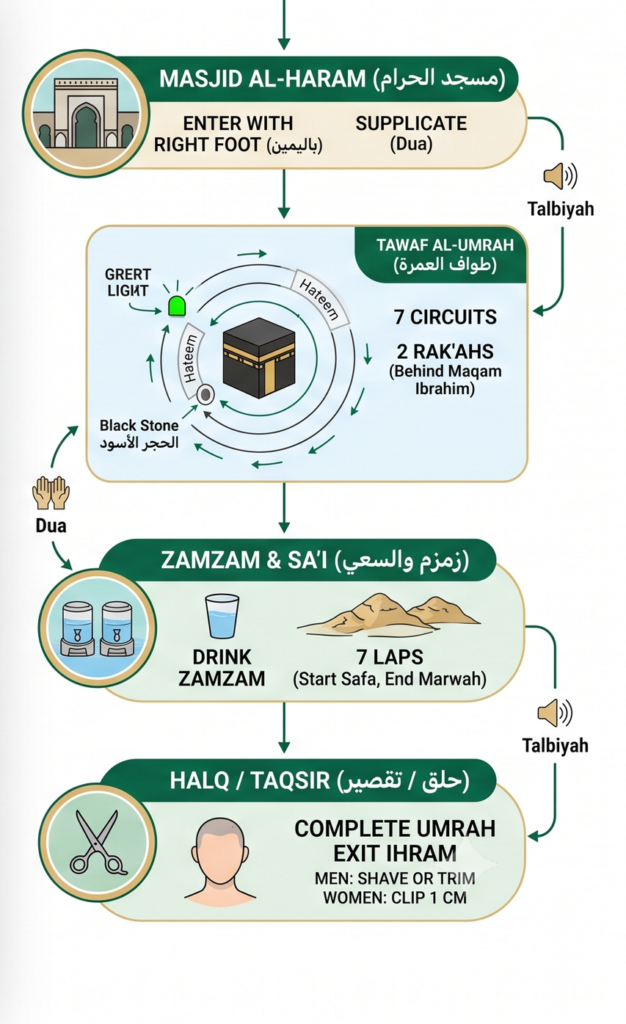
       [ 1. MIQAT ]  ───► Enter State of Ihram & Declare Niyyah
            │
            ▼
       [ 2. TAWAf ]  ───► 7 Anti-Clockwise Circuits + 2 Rak'ahs at Maqam Ibrahim
            │
            ▼
       [ 3. SA'I ]   ───► 7 Laps: Mount Safa to Mount Marwah
            │
            ▼
       [ 4. HALQ ]   ───► Hair Shaving / Trimming to Complete Umrah & Exit Ihram
The Physical Preparation (Sunnah Acts)
- Perform a full body wash (Ghusl).
- Clip nails, trim the mustache, and remove unwanted body hair.
- Men may apply perfume to their skin or beard before making the intention, but never onto the Ihram garments themselves.
The Ihram Attire
- For Men: Two clean, unstitched white sheets—the Izar (wrapped securely around the waist covering navel to below knees) and the Rida (draped over the shoulders). Stitched underwear, shirts, and head coverings are strictly prohibited. Footwear must leave the ankle and the upper bridge of the foot uncovered.
- For Women: Standard modest, loose-fitting Islamic clothing covering the entire body except the hands and face. No specialized color is required (black, white, or neutral tones are common). Face veils (Niqab) and gloves should not be worn while in Ihram.
Strict Prohibitions Once in Ihram
- Cutting or plucking hair and nails.
- Applying perfume or using scented soaps/wipes.
- Men covering their heads with caps, towels, or hoods.
- Hunting animals or uprooting greenery in the Haram sanctuary.
- Marital relations or intimate contact.
- Arguing, foul speech, or losing one’s temper in crowds.
2. Entering Ihram at the Miqat & Declaring the Niyyah
Pilgrims must enter the state of Ihram before crossing the geographic boundaries known as the Miqat:
- Coming from Madinah: Dhu’l-Hulayfah (Abyar Ali)
- Flying from outside Saudi Arabia directly to Jeddah: Enter Ihram and make your intention on the airplane approximately 30 minutes before entering Saudi airspace (the airline cabin crew will announce when approaching the Miqat boundary).
The Intention (Niyyah)
Make the intention verbally and in your heart:
لَبَّيْكَ اللَّهُمَّ عُمْرَةً
Labbayka Allahumma ‘Umrah.
“Here I am, O Allah, for Umrah.”
Immediately begin reciting the Talbiyah frequently, raising your voice slightly (for men) or reciting quietly (for women):
لَبَّيْكَ اللَّهُمَّ لَبَّيْك، لَبَّيْكَ لاَ شَرِيكَ لَكَ لَبَّيْك، إِنَّ الْحَمْدَ وَالنِّعْمَةَ لَكَ وَالْمُلْك، لاَ شَرِيكَ لَك
Labbayka Allahumma labbayk, labbayka laa shareeka laka labbayk. Innal-hamda wan-ni’mata laka wal-mulk, laa shareeka lak.
“Here I am, O Allah, here I am. Here I am, You have no partner, here I am. Verily all praise, blessings, and sovereignty belong to You. You have no partner.”
Continue reciting the Talbiyah during your journey to Makkah, while checking into your hotel, and until you reach the edge of the Mataaf to start Tawaf.
3. Entering Masjid al-Haram & First Sight of the Kaaba
- Enter through any open gate (such as Bab King Abdulaziz, Bab King Fahd, or Bab as-Salam) stepping in with your right foot first.
- Recite the standard mosque supplication:بِسْمِ اللَّهِ، وَالصَّلَاةُ وَالسَّلَامُ عَلَى رَسُولِ اللَّهِ، اللَّهُمَّ افْتَحْ لِي أَبْوَابَ رَحْمَتِكَBismillahi was-salatu was-salamu ‘ala Rasulillah. Allahummaftah li abwaba rahmatik.“In the name of Allah, and blessings and peace upon the Messenger of Allah. O Allah, open for me the doors of Your mercy.”
- The First Sight of the Kaaba: Keep your gaze lowered until you reach the open courtyard. When your eyes fall upon the Kaaba, move to the side away from the walking crowd, raise your hands, and supplicate fervently. This is one of the most powerful moments where supplications are answered.
4. Tawaf al-Umrah (Circling the Holy Kaaba)
Tawaf requires ritual purity (Wudhu). If your Wudhu breaks during Tawaf, exit the flow, use the courtyard facilities to renew it, and resume your count.
                     ┌──────────────────┐
                     │     HATEEM       │
                     │  (Semi-Circle)   │
                     └──────────────────┘
                      [Do Not Cut Inside]
                     ┌──────────────────┐
                     │                  │
                     │      KAABA       │
                     │                  │
                     └──────────────────┘
                 Rukn Yamani       Black Stone (Hajar al-Aswad)
                      ▲                  │
                      │                  ▼
               [ Recite Dua ]     START & FINISH LINE
                                  (Green Light on Wall)
Sunnah Practices Before You Step Onto the Mataaf
- Idtiba’ (Men only): Uncover your right shoulder by passing the top Ihram sheet under your right armpit and draping both ends over your left shoulder. Keep the shoulder bared only during Tawaf.
- Stop the Talbiyah: As soon as you step up to begin Tawaf, cease reciting the Talbiyah.
The 7 Circuits
- The Starting Point: Align yourself with the corner of the Black Stone (Hajar al-Aswad). Look up at the opposite outer wall for the bright green indicator light marking the exact line.
- Istilam (Saluting the Black Stone): Stand facing the line, raise both palms toward the Black Stone, and say:بِسْمِ اللَّهِ، اللَّهُ أَكْبَرُBismillahi, Allahu Akbar.
- Walking the Circuits: Walk counter-clockwise, keeping the Kaaba on your left side. Ensure you walk around the outside of the semi-circular wall (Al-Hateem / Hijr Ismail); entering inside the Hateem invalidates that circuit because it is part of the Kaaba itself.
- Raml (Men only): During the first 3 circuits, men walk briskly with small, energetic steps. In the remaining 4 circuits, walk at a normal, comfortable pace.
- Between the Yemeni Corner (Rukn al-Yamani) and the Black Stone: During each of the 7 laps, recite this Quranic supplication between these two corners:رَبَّنَا آتِنَا فِي الدُّنْيَا حَسَنَةً وَفِي الآخِرَةِ حَسَنَةً وَقِنَا عَذَابَ النَّارِRabbana atina fid-dunya hasanatan wa fil-akhirati hasanatan wa qina ‘adhaban-nar.“Our Lord, grant us good in this world and good in the Hereafter, and protect us from the punishment of the Fire.”
- Other Duas: There are no mandatory scripts for the rest of each circuit. Read Quran, recite personal supplications in your own language, and make continuous Dhikr.
After Completing 7 Laps
- Cover the Right Shoulder: Men cover their right shoulder immediately once the 7th circuit is finished.
- Two Rak’ahs of Salah: Pray 2 Rak’ahs behind Maqam Ibrahim (Station of Abraham) if space permits. If the immediate area is crowded, pray anywhere on the Mataaf or within the Haram. In the 1st Rak’ah, recite Surah Al-Kafirun; in the 2nd Rak’ah, recite Surah Al-Ikhlas.
- Drink Zamzam: Drink from the cold Zamzam dispensers available throughout the mosque, face the Kaaba, and make heartfelt supplication for wellness and healing.
5. Sa’i Between Mount Safa and Mount Marwah
Proceed through the designated indoor corridor to Mount Safa to begin the 7 lengths of Sa’i. While Wudhu is not strictly mandatory for Sa’i, maintaining it is recommended.
- Ascending Safa: As you approach Mount Safa, recite:إِنَّ الصَّفَا وَالْمَرْوَةَ مِن شَعَائِرِ اللَّهِInnas-Safa wal-Marwata min sha’a’irillah.“Indeed, Safa and Marwah are among the symbols of Allah.”
- Facing the Kaaba from Safa: Look toward the Kaaba, raise your hands in dua, and recite:اللَّهُ أَكْبَرُ، اللَّهُ أَكْبَرُ، اللَّهُ أَكْبَرُ، لاَ إِلَهَ إِلاَّ اللَّهُ وَحْدَهُ لاَ شَرِيكَ لَهُ، لَهُ الْمُلْكُ وَلَهُ الْحَمْدُ يُحْيِي وَيُمِيتُ وَهُوَ عَلَى كُلِّ شَيْءٍ قَدِيرٌAllahu Akbar, Allahu Akbar, Allahu Akbar. La ilaha illallahu wahdahu la shareeka lah, lahul-mulku wa lahul-hamdu, yuhyee wa yumeetu, wa Huwa ‘ala kulli shay’in Qadeer.
- Walking to Marwah (Lap 1): Walk down toward Mount Marwah.
- The Green Neon Markers: Between two clearly lit green neon track zones, men should jog/run briskly (following the footsteps of Lady Hajar searching for water). Women walk at their normal pace throughout.
- Reaching Marwah: When reaching Marwah, face the Kaaba, raise your hands, and repeat the same Dhikr recited on Safa. This marks the completion of your 1st lap.
- The 7 Laps Count:
- Safa to Marwah = Lap 1
- Marwah to Safa = Lap 2
- Safa to Marwah = Lap 3
- Marwah to Safa = Lap 4
- Safa to Marwah = Lap 5
- Marwah to Safa = Lap 6
- Safa to Marwah = Lap 7 (Your Sa’i ends at Mount Marwah)
6. Halq or Taqsir (Exiting Ihram)
Once the 7th lap finishes at Mount Marwah, the final obligatory rite is cutting the hair:
- For Men:
- Halq (Shaving the head completely): Highly recommended and carries threefold the reward of trimming based on the Prophet’s ﷺ supplication.
- Taqsir (Trimming): Clipping hair evenly across the entire head by at least the length of a fingertip (approx. 2 cm).
- For Women:
- Gather your hair into a ponytail and clip the length of a single fingertip (approx. 1 to 2 cm) from the ends. Women never shave their heads.
Finding Barbershops Around the Haram
Do not attempt to cut your own hair or let fellow pilgrims cut your hair while still inside the prayer halls with non-sanitized tools.
- Exit through the lower courtyards or the Marwah plaza exits.
- Head directly toward the licensed barbershop complexes located beneath the Makkah Clock Tower (Abraj Al Bait) commercial mall, the Jabal Omar complex, or along Ibrahim Al Khalil Street.
- Licensed Saudi municipality barbers follow single-use disposable blades, ensuring sterile, safe, and swift grooming.
Congratulations — Umrah Mubarak!
Once your hair is shaved or trimmed, all prohibitions of Ihram are lifted. You may shower, change into your everyday attire, and resume normal daily activities.
Comments